
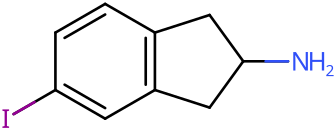
5-IAI Stats & Data
NC1Cc2ccc(I)cc2C1BIHPYCDDPGNWQO-UHFFFAOYSA-NReceptor Profile
Receptor Actions
Effect Profile
CuratedMild auditory effects with low body load, visuals, and headspace
Strong sensory enhancement with moderate euphoria, mild empathy and stimulation
Mild euphoria with moderate anxiety/jitters, low stimulation and focus
Tolerance & Pharmacokinetics
drugs.wikiTolerance Decay
Pattern extrapolated from MDMA‑like releasers and aminoindane reports: acute tachyphylaxis within a session, partial tolerance over 1–2 weeks, and return to near‑baseline by ~4–6 weeks with abstinence. Data quality low due to absence of controlled human studies.
Cross-Tolerances
Legal Status
| Country | Status | Notes |
|---|---|---|
| Finland | Scheduled in the "government decree on psychoactive substances banned from the consumer market". | |
| Sweden | Sweden's public health agency suggested classifying 5-IAI as a hazardous substance, on September 25, 2019. |
Harm Reduction
drugs.wiki• Identity uncertainty is a major risk: multiple forum analyses from 2010–2013 allege that products sold as “5‑IAI” were often inactive or different stimulants; treat all samples as unknown until reagent‑tested and, where available, lab drug checking confirms identity. This directly affects dose, onset, and safety planning.
• Mechanistically, 5‑IAI behaves as a serotonin>norepinephrine≈dopamine releasing agent and substituted for MDMA in rodent discrimination studies, implying entactogenic effects with stimulant load; human data remain anecdotal.
• Animal work found markedly less serotonergic neurotoxicity than para‑iodoamphetamine at comparable high doses, yet small decreases in serotonergic markers occurred; avoid high/repeated dosing.
• A modern review notes affinity at 5‑HT2B among other 5‑HT receptors; while functional agonism is not fully characterized, conservative spacing is advised (valvulopathy is a theoretical risk across 5‑HT2B‑active entactogens).
• Expect typical releaser risks: hyperthermia, tachycardia, and hyponatremia with overhydration or MDMA‑style water‑loading; use small, regular sips (~250 ml/hour in heat) and avoid alcohol‑induced dehydration. (General HR extrapolated to serotonergic releasers.)
• Bruxism, muscle tension, and insomnia are common; magnesium may help bruxism for some but evidence is mixed; non‑drug measures (jaw rests, gum, warm compress) are lower‑risk first‑line.
• Redosing yields diminishing returns and disproportionate side effects; plan a single dose, avoid stacking, and do not chase effects with stimulants. (Pattern observed across community reports.)
• Space sessions generously (≥4–6 weeks) to allow serotonergic recovery and reduce mood after‑effects; shorter intervals correlate with more severe comedowns across releasers. (Best‑practice HR extrapolation.)
• If on any serotonergic prescription (SSRI/SNRI/MAOI/triptan), avoid entirely due to elevated serotonin syndrome risk highlighted in HR lists and combo charts.
• Non‑selective beta‑blockers during acute stimulation may worsen vasoconstriction; if chest pain, severe headache, hyperthermia, or confusion occur, seek emergency care rather than self‑medicating.
• Prefer oral titration over insufflation/rectal to reduce local harm and dose overshoot; nasal use commonly reports irritation without clear benefit.
• Because formal human PK is lacking, treat timing and interactions as uncertain; build extra buffers before driving, sleeping, or combining with any other psychoactives.
References
Data Sources
Cited References
- Bluelight: The 5-IAI Thread (2010)
- Coppola M & Mondola R. 5-IAI: chemistry, pharmacology and toxicology (Toxicol Lett 2013)
- Nichols DE et al. 5-Iodo-2-aminoindan, a nonneurotoxic analogue of p-iodoamphetamine (Pharmacol Biochem Behav 1991)
- Pinterova N et al. Synthetic Aminoindanes: A Summary of Existing Knowledge (Front Psychiatry 2017)
- Sainsbury PD et al. Aminoindanes—the next wave of 'legal highs'? (Drug Test Anal 2011)
- Simmler LD et al. Pharmacological profiles of aminoindanes, piperazines, and pipradrol derivatives (Biochem Pharmacol 2014)
- Nichols DE et al. 5-Iodo-2-aminoindan, a non-neurotoxic analogue of p-iodo-amphetamine (Pharmacol Biochem Behav 38, 1991)
- Coppola M & Mondola R. 5-IAI: chemistry, pharmacology and toxicology of a research chemical producing MDMA-like effects (Toxicol Lett 218, 2013)
- Long-term behavioural effects of 5-IAI in adolescent rats (Pulsus Journals, 2018)
- ScienceDirect: S0378427413000210
Additional references
- PubChem entry: 5‑Iodo‑2‑aminoindan (CID 131506) – identifiers/synonyms
- Coppola & Mondola 2013 – 5‑IAI chemistry, pharmacology, toxicology (review)
- Oeri 2021 – Alternative entactogens review (5‑IAI pharmacology, receptor notes)
- Bluelight dangerous combinations list (explicitly lists 5‑IAI under serotonin releasers)
- Bluelight discussion highlighting alleged widespread mislabeling of ‘5‑IAI’ (2010s)
- Bluelight trip/experience discussions for 5‑IAI (dose/ineffectiveness/mislabelling anecdotes)
- Drugs‑Forum 5‑IAI wiki (general overview; aminoindane context)