
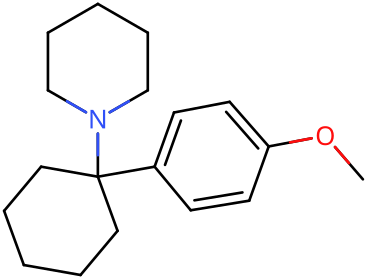
4-MeO-PCP Stats & Data
COc1ccc(cc1)C1(CCCCC1)N1CCCCC1MUZGGFNYVLGUFS-UHFFFAOYSA-NReceptor Profile
Receptor Actions
Receptor Binding
History & Culture
4-MeO-PCP was originally synthesized in 1965 by Victor Maddox, a medicinal chemist working at the pharmaceutical company Parke-Davis. The compound remained largely obscure for decades following its initial creation. Interest in 4-MeO-PCP resurfaced in the late 1990s when a chemist writing under the pseudonym John Q. Beagle published a 1999 review suggesting that the substance possessed reduced potency compared to its parent compound PCP. In 2001, Beagle followed this with a more comprehensive publication detailing the synthesis procedure and describing the qualitative effects, estimating its potency at approximately 70% that of PCP. The compound holds a notable place in the history of online research chemical markets as the first arylcyclohexylamine to be sold through internet vendors. It was introduced to the market in late 2008 by a supplier operating under the name CBAY. This marked the beginning of a wave of related dissociative compounds entering the research chemical scene, with 3-MeO-PCP and methoxetamine (MXE) following shortly thereafter.
Subjective Effects
Physical
- Tactile disconnection
- Spontaneous tactile sensations
- Tactile suppression
- Physical autonomy
- Motor control loss
- Physical euphoria
- Perception of decreased weight
- Dizziness
- Nausea
- Visual sliding
Cognitive
- Depersonalization
- Derealization
- Consciousness disconnection
- Memory suppression
- Ego death
- Thought deceleration
- Immersion enhancement
- Information processing suppression
- Time distortion
- Euphoria
- Introspection
- Déjà vu
- Conceptual thinking
- Unity and interconnectedness
- Compulsive redosing
- Anxiety suppression
- Disinhibition
- Amnesia
- Creativity enhancement
Sensory
- Suppression
- Distortions
- Hallucinations
- Perspective distortions
- Environmental cubism
- Environmental orbism
- Scenery slicing
- Internal hallucinations: (autonomous entities; settings, sceneries, and landscapes; alterations in perspective and scenarios and plots)
- Visual disconnection: This eventually results in 4-MeO-PCP's equivalent of the famous "k-hole" or, more specifically, holes, spaces and voids alongside of structures.
- Visual acuity suppression
- Double vision
- Pattern recognition suppression
- Frame rate suppression
Forked from Subjective Effect Documentation work by Josie Kins, August 2016. Via dose.wiki (CC0).
Toxicity
PsychonautWikiThe toxicity and long-term health effects of recreational 4-MeO-PCP use do not seem to have been studied in any scientific context and the exact toxic dosage is unknown. This is because 4-MeO-PCP has very little history of human usage. Anecdotal evidence from people who have tried 4-MeO-PCP within the community suggest that there do not seem to be any negative health effects attributed to simply trying this drug at low to moderate doses by itself and using it sparingly (but nothing can be completely guaranteed). Independent research should always be done to ensure that a combination of two or more substances is safe before consumption. It is strongly recommended that one use harm reduction practices when using this drug.
Effect Profile
Curated + 7 ReportsStrong dissociative depth and insight with strong mania and motor impairment
Duration Timeline
BluelightCommunity Effects
TripSitTolerance & Pharmacokinetics
drugs.wikiTolerance Decay
Experience Report Analysis
ErowidDemographics
Gender Distribution
Too few reports for a chart: gender is known from 7 reports, and a split is drawn only from 20 reports or more. Counts are shown instead. Why 20?
- Male 7 of 7
Age Distribution
Reports Over Time
Effect Analysis
ErowidEffects aggregated from 7 experience reports (7 single-substance Erowid)
Effect Sentiment Distribution
Confidence Distribution
Each bar is the share of reports mentioning the effect; its whisker, and the band on the rows below, is the 95% interval: where the share could plausibly be with other reports of the same kind.
Too few reports for bars: these effects come from 7 single-substance Erowid reports, and a bar is drawn only from 20 reports or more. With fewer, a percentage cannot tell a common effect from a rare one. Counts are shown instead. Why 20?
Positive Effects 1
Adverse Effects 2
Show 3 neutral or unclassified mentions
Real-World Dose Distribution
ErowidFrom 10 of 13 recorded dose entries: those that state a weight (mg, g or µg), in routes with at least five of them. Values above Q3 + 3×IQR, far above what people typically take, are left out; they can include real heavy doses and overdoses, not only mistakes.
Oral (n=10)
Form / Preparation
Most common forms and preparations, as a share of the 4 reports that give one
Too few reports for bars: these forms come from 4 reports, and a bar is drawn only from 20 reports or more. With fewer, a percentage cannot tell a common effect from a rare one. Counts are shown instead. Why 20?
- Powder / Crystals 3 of 4
Legal Status
| Country | Status | Notes |
|---|---|---|
| Chile | Illegal | Prohibited under Ley 20000 (the Chilean drug control law), which explicitly covers all esters and ethers of phencyclidine. As 4-MeO-PCP is an ether of PCP, it falls under this provision. |
| Germany | Controlled (NpSG) | Controlled substance under the Neue-psychoaktive-Stoffe-Gesetz (New Psychoactive Substances Act) since September 27, 2021. Production, distribution, and possession with intent to supply are prohibited. |
| Sweden | Proposed hazardous substance | Sweden's public health agency recommended classifying 4-MeO-PCP as a hazardous substance on November 10, 2014. |
| Switzerland | Controlled (Verzeichnis E) | Specifically named as a controlled substance under Verzeichnis E of Swiss narcotics legislation. |
| Turkey | Illegal | Classified as a controlled drug under national legislation. Possession, production, supply, and importation are prohibited. |
| United Kingdom | Class B | Controlled under the Misuse of Drugs Act 1971. Covered by the arylcyclohexylamine generic clause added by S.I. 2013/239, which came into effect on February 26, 2013. This clause encompasses derivatives of 1-phenylcyclohexylamine where the amine has been replaced with a piperidyl group and further substituted in the phenyl ring with an alkoxy substituent. Possession, production, supply, and importation are prohibited. |
| United States | Unscheduled (Federal Analogue Act may apply) | Not federally scheduled, but may be prosecuted as a PCP analogue under the Federal Analogue Act when sold for human consumption or possessed with intent to ingest. The DEA has indicated it considers structurally similar recreational drugs to be controlled substance analogues. Virginia temporarily classified it as Schedule I from June 26, 2019 through December 25, 2020. |
References
Cited References
- Bluelight: The Big & Dandy 4-MeO-PCP Thread
- Drugs-Forum: 4-MeO-PCP (Methoxydine) Drug Info
- Erowid: 4-MeO-PCP Vault
- Isomer Design: 4-MeO-PCP
- Morris H, Wallach J. From PCP to MXE: A comprehensive review of the non-medical use of dissociative drugs
- Roth BL et al. The Ketamine Analogue Methoxetamine and 3- and 4-Methoxy Analogues of Phencyclidine Are High Affinity and Selective Ligands for the Glutamate NMDA Receptor