
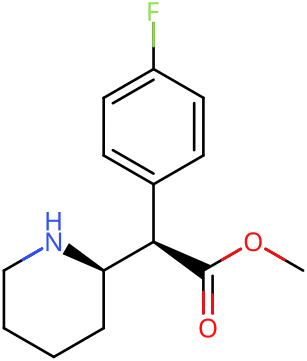
4-Fluoromethylphenidate Stats & Data
COC(=O)C(C1CCCCN1)c1ccc(F)cc1XISBAJBPDVRSPG-UHFFFAOYSA-NInteraction Warnings
The neurotoxic effects of MDMA may be increased when combined with other stimulants.
This combination may increase strain on the heart.
Toxicity
PsychonautWikiThe toxicity and long-term health effects of recreational 4F-MPH use do not seem to have been studied in any scientific context and the exact toxic dosage is unknown. This is because 4F-MPH is a research chemical with very little history of human usage. Anecdotal evidence from people who have tried 4F-MPH suggests that there are no negative health effects attributed to simply trying the drug by itself at low to moderate doses and using it very sparingly (but nothing can be completely guaranteed). Independent researchshould always be done to ensure that a combination of two or more substances is safe before consumption. It is strongly recommended that one use harm reduction practices when using this drug.
Effect Profile
Curated + 7 ReportsStrong focus with strong anxiety/jitters, mild stimulation and euphoria
Tolerance & Pharmacokinetics
drugs.wikiTolerance Decay
Typical phenidate pattern: tolerance builds over repeated days of use and partially resets after 1–2 weeks off. Cross‑tolerance within phenidates is expected via shared DAT/NET mechanisms, though exact ratios vary across isomers and ROAs. Data quality is primarily anecdotal/community‑based.
Cross-Tolerances
Experience Report Analysis
ErowidDemographics
Gender Distribution
Too few reports for a chart: gender is known from 15 reports, and a split is drawn only from 20 reports or more. Counts are shown instead. Why 20?
- Male 13 of 15
- Not Specified 2 of 15
Age Distribution
Reports Over Time
Effect Analysis
ErowidEffects aggregated from 7 experience reports (7 single-substance Erowid)
Effect Sentiment Distribution
Confidence Distribution
Each bar is the share of reports mentioning the effect; its whisker, and the band on the rows below, is the 95% interval: where the share could plausibly be with other reports of the same kind.
Too few reports for bars: these effects come from 7 single-substance Erowid reports, and a bar is drawn only from 20 reports or more. With fewer, a percentage cannot tell a common effect from a rare one. Counts are shown instead. Why 20?
Positive Effects 3
Adverse Effects 2
Show 1 neutral or unclassified mention
Also reported in combinations. In the 8 4-Fluoromethylphenidate reports where another drug was taken too, 1 mentions hospital, emergency services or an overdose, 0 a seizure and 1 psychosis (too few reports for percentages). In the 7 single-substance reports: 0, 0 and 0. These are not in the figures above: they cannot be put down to 4-Fluoromethylphenidate alone, and a mention is not always something that happened to the writer.
Real-World Dose Distribution
ErowidFrom 140 of 145 recorded dose entries: those that state a weight (mg, g or µg), in routes with at least five of them. Values above Q3 + 3×IQR, far above what people typically take, are left out; they can include real heavy doses and overdoses, not only mistakes.
Rectal (n=100)
Oral (n=29)
Insufflated (n=10)
Form / Preparation
Most common forms and preparations, as a share of the 7 reports that give one
Too few reports for bars: these forms come from 7 reports, and a bar is drawn only from 20 reports or more. With fewer, a percentage cannot tell a common effect from a rare one. Counts are shown instead. Why 20?
- Powder / Crystals 4 of 7
- Pill / Tablet 2 of 7
Redose Patterns
Redosing behavior across 10 reports
Too few reports for a chart: redosing is known from 10 reports, and a split is drawn only from 20 reports or more. Counts are shown instead. Why 20?
- Single dose 5 of 10
- Redosed 5 of 10
Harm Reduction
drugs.wikiBatch variability has become a major risk factor: recent reports suggest some supplies are weaker or racemic (higher erythro content) requiring several-fold higher doses than older threo‑rich batches; this tempts redosing and increases harm. Mis‑selling has been documented by drug checking services (e.g., 4F‑MPH sold as 4‑FA and mixed with caffeine/MDMA), so check samples where possible and always start with an allergy dose. Oral use is generally lower‑risk for nasal tissue than insufflation; if insufflating, use small, well‑spaced bumps, rotate nostrils, and use sterile saline to reduce damage. Because active dosing is in the single‑milligram range for many users, a 0.001 g scale and preferably volumetric dosing are strongly recommended to avoid overshooting. Allow at least 2 hours after an oral dose before considering any redose; creeping effects and long tails make premature redosing a common pitfall. Expect pronounced vasoconstriction in some users (cold extremities, tingling); escalating doses to overcome this can worsen cardiovascular strain without adding desired effects. Sleep debt dramatically increases psychiatric risks (paranoia, anxiety, dysphoria); set a hard cutoff time and plan sleep hygiene. People with hypertension, arrhythmia, or other cardiovascular disease should avoid 4F‑MPH; if chest pain, severe headache, or palpitations occur, stop and seek medical advice. Avoid combining with MDMA or other stimulants due to additive heart‑rate/BP and overheating risks; if on antidepressants, avoid poly‑serotonergic stacks and monitor for agitation, tremor, sweating, or clonus. Harm‑reduction essentials: reagent/lab test where available; keep hydration modest and electrolytes balanced; avoid alcohol; do not drive; and do not eyeball doses.
References
Cited references
- Drug Users Bible – 4F‑MPH overview, dose table, duration
- TripSit – Main site, combo chart and factsheet hub; volumetric dosing tool referenced
- TripSit Wiki – Drug combinations (stimulant + other classes)
- Erowid – 4F‑MPH Experience Vaults (general)
- Erowid – 4F‑MPH ‘What Was in That?’ section (misidentified/mixed samples)
- Bluelight – 4F‑MPH megathread (onset, potency, binge/psychosis risks)
- Bluelight – 4F‑MPH discussion (potency, isomer comments, nasal harm)
- Reddit r/researchchemicals – Batch variability and isomer mix reports (2023–2024)
- Reddit r/researchchemicals – 4F‑MPH hangover/next‑day dysphoria; SSRI user anecdotes
- Saferparty Zürich – Warning: 4F‑MPH sold as 4‑FA with caffeine/MDMA (mis‑selling; dose mismatch risk)
- Drug Checking Community (Toronto) – Service information (lab drug checking availability)