
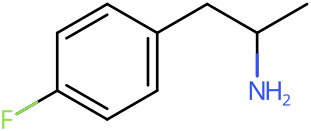
4-FA Stats & Data
CC(N)Cc1ccc(F)cc1DGXWNDGLEOIEGT-UHFFFAOYSA-NInteraction Warnings
4-FA can be potentially dangerous in combination with other stimulants as it can increase one's heart rate and blood pressure to dangerous levels.
This combination may increase strain on the heart.
Receptor Profile
Receptor Actions
History & Culture
1940s–1960s
4-Fluoroamphetamine was first synthesized in the early 1940s, though no records exist of the compound being tested in humans for many years following its initial preparation. During the 1960s, researchers began investigating 4-FA alongside other para-substituted amphetamine derivatives in animal studies, examining how various halogen substituents at the para position of the phenyl ring affected pharmacological activity.
2001–present
4-FA became commercially available as a research chemical around 2001 and gradually established itself in the online grey market alongside related fluorinated amphetamines such as 2-FMA and 3-FA. The first confirmed detection in Europe occurred in Germany in 2003. Very little formal data existed regarding its pharmacological properties, metabolism, or toxicity, and the compound had only a brief documented history of human use. The substance's contemporary history began in earnest between 2007 and 2008, when it started appearing throughout Europe with particular prevalence in the Netherlands. Initial detections were traced to organized crime groups involved in amphetamine production who had begun using 4-fluoro-P2P as a precursor to synthesize 4-FA as an alternative product. During this early period, the compound was frequently misrepresented and sold as either amphetamine or MDMA rather than under its own identity. The market began shifting around 2009. The Netherlands reported an increase in intentionally purchased 4-FA, and seizures across the rest of Europe became more common. That year also saw multiple cases of 4-FA appearing in tablets sold as ecstasy in Switzerland, where it became a comparatively popular novel psychoactive substance. By 2010, at least twelve European countries had detected the compound through forensic analysis and consumer drug testing services.
2009–2017
4-FA achieved particular popularity in the Netherlands during the early 2010s. By 2013, the compound was more commonly purchased intentionally than misrepresented, ranking among the top four novel psychoactive substances detected in Dutch drug testing facilities. Surveys conducted during this period indicated that 77% of Dutch users selected 4-FA specifically for its effects—commonly described as occupying a subjective position between amphetamine and MDMA—while only 18% cited its legal status as their primary motivation. This period of widespread availability ended when the Netherlands scheduled the compound in May 2017.
Subjective Effects
In comparison to other substituted amphetamines, 4-FA is particularly free of side effects such as nausea, high blood pressure, anxiety and an uncomfortable offset. In low doses, it is considered to be an extremely functional and effective nootropic for performing tasks or general productivity of any sort. At higher dosages, however, it becomes dysfunctional and recreational due to the intensity of its euphoria and stimulation.
Physical
- Stimulation
- Tactile enhancement
- Physical euphoria
- Dehydration
- Appetite suppression
- Increased heart rate
- Increased perspiration
Cognitive
- Euphoria: This effect can be described in its manifestation as a series of euphoric waves that recede and reappear randomly throughout the experience.
- Empathy, love and sociability enhancement: In comparison to other substances, this effect can be described as identical to the effects produced by MDMA, but with less intensity.
- Thought acceleration
- Thought connectivity
- Focus enhancement
- Ego inflation
- Wakefulness
- Analysis enhancement
- Motivation enhancement
- Sexual arousal
- Novelty enhancement
- Compulsive redosing
Forked from Subjective Effect Documentation by Josie Kins, August 2015. Via dose.wiki (CC0).
Toxicity
PsychonautWikiThe toxicity and long-term effects of recreational 4-FA use have only scarcely been studied because 4-FA has very little history of human usage. Anecdotal evidence, as well as several case reports, suggest there is a small to moderate individual health risk associated with the use of 4-FA. Among these, it appears there is an especially a high risk for acute cardiovascular toxicity. Some people in the Netherlands, only using a moderate dose, have died due to cardiac arrest or suffered severe brain damage due to a stroke. The mechanism of this acute toxicity is not yet known, but it seems as though the stroke starts off as an intense headache or even a migraine attack, that slowly worsens.
Effect Profile
Curated + 45 ReportsStrong auditory effects with strong body load, moderate visuals, mild headspace
Strong empathy, euphoria, stimulation, and sensory enhancement
Strong stimulation, euphoria, and focus with strong anxiety/jitters
Tolerance & Pharmacokinetics
drugs.wikiTolerance Decay
Anecdotal: tolerance builds quickly with repeated/weekly use and decays over 2–4+ weeks; cross-tolerance likely overlaps with other amphetamine-like stimulants and serotonergic releasers. Data quality is limited.
Cross-Tolerances
Demographics
Gender Distribution
Age Distribution
Reports Over Time
Effect Analysis
Erowid + BluelightEffects aggregated from 45 experience reports (27 single-substance Erowid + 18 Bluelight)
Effect Sentiment Distribution
Confidence Distribution
Each bar is the share of reports mentioning the effect; its whisker, and the band on the rows below, is the 95% interval: where the share could plausibly be with other reports of the same kind.
Rows resting on fewer than 20 reports show a count (“3 of 7”) instead of a bar. Why 20?
Positive Effects 30
Adverse Effects 32
Show 12 more adverse effects
Show 15 neutral or unclassified mentions
Also reported in combinations. In the 30 4-FA reports where another drug was taken too, 2 (6.7%) mention hospital, emergency services or an overdose, 0 (0.0%) a seizure and 1 (3.3%) psychosis. In the 27 single-substance reports: 3.7%, 0.0% and 0.0%. These are not in the figures above: they cannot be put down to 4-FA alone, and a mention is not always something that happened to the writer.
Dosage Distribution
Dose distribution from experience reports, one dose per report (the first listed). Doses above Q3 + 3×IQR, far above what people typically take, are left out of the median and range and listed under each route: most are real heavy doses or overdoses, not mistakes.
1 report gave a dose above the typical range (240 mg), so it is not in the figures above. Listing a dose here does not mean it is safe.
Show the report
Real-World Dose Distribution
ErowidFrom 87 of 105 recorded dose entries: those that state a weight (mg, g or µg), in routes with at least five of them. Values above Q3 + 3×IQR, far above what people typically take, are left out; they can include real heavy doses and overdoses, not only mistakes.
Insufflated (n=9)
Oral (n=77)
Common Combinations
Most co-occurring substances, as a share of all 57 reports filed under 4-FA; whiskers are 95% intervals
Form / Preparation
Most common forms and preparations, as a share of the 37 reports that give one; whiskers are 95% intervals
Body-Weight Dosing
Dose per kg of body weight, one dose per report (the first listed), from reports giving a weight of 30–250 kg. Doses above Q3 + 3×IQR, far above what people typically take, are left out of the median and range and listed under each route.
2 reports gave a dose above the typical range (3.704–4.732 mg/kg), so they are not in the figures above. Listing a dose here does not mean it is safe.
Show the reports
Redose Patterns
Redosing behavior across 40 reports
Legal Status
| Country | Status | Notes |
|---|---|---|
| Australia | Controlled | Prohibited substance under national drug legislation as an amphetamine analogue. |
| Austria | NPSG | Illegal to possess, produce, and sell under the Neue-Psychoaktive-Substanzen-Gesetz (New Psychoactive Substances Act). |
| Belgium | Controlled | Prohibited substance under national drug legislation. |
| Brazil | Lista F2 | Added to Lista F2 under Portaria SVS/MS nº 344 in July 2015. Possession, production, and sale are prohibited. |
| Bulgaria | Controlled | Prohibited substance under national drug legislation. |
| Canada | Schedule III CDSA (as amphetamine analogue) | Not specifically listed under the Controlled Drugs and Substances Act, but Health Canada considers it an analogue of amphetamine under Item 1 of Schedule III, which includes amphetamines, their salts, derivatives, isomers, and analogues. |
| Chile | Controlled | Prohibited substance under national drug legislation. |
| China | Category I psychotropic substance | Controlled as a Category I psychotropic substance under SFDA regulations. Sale, purchase, import, export, and manufacture are illegal. |
| Croatia | Controlled | Prohibited substance under national drug legislation. |
| Czech Republic | Banned | Prohibited substance under national drug legislation. |
| Finland | Narcotic substance | Scheduled in the government decree on narcotic substances, preparations, and plants. Possession, production, and distribution are prohibited. |
| France | Stupéfiant (Annexe IV) | Scheduled as a controlled narcotic since 2012. Possession, purchase, sale, and manufacture are prohibited under French drug legislation. |
| Germany | Anlage I BtMG | Added to Anlage I of the Betäubungsmittelgesetz (Narcotics Act) in 2012. Manufacturing, possession, import, export, purchase, sale, and dispensing without a license are prohibited. |
| Hungary | Controlled | Became a controlled substance in January 2012 under national drug legislation. |
| Israel | Controlled | Added to the list of controlled substances in December 2007. Buying, selling, and possession are prohibited. |
| Italy | Tabella I | Listed in Tabella I of the controlled substances tables (Tabelle delle sostanze stupefacenti e psicotrope). Possession, purchase, and sale are prohibited. |
| Netherlands | Schedule 1 (Opiumwet) | Controlled under the Opium Act as of May 25, 2017. Prior to scheduling, 4-FA was notably popular in the Netherlands, with surveys indicating 77% of users chose it for its specific effects rather than its legal status. |
| New Zealand | Schedule 3 (Class C) | Controlled as a Class C substance under the Misuse of Drugs Act due to classification as an amphetamine analogue. |
| Poland | Controlled | Listed as a controlled substance under national drug legislation. |
| Serbia | Controlled | Controlled substance as of April 2013 under national drug legislation. |
| Slovakia | Controlled | Controlled substance as of March 1, 2011 under national drug legislation. |
| South Korea | Controlled | Controlled substance as of August 27, 2014 under national drug legislation. |
| Sweden | Controlled | Prohibited substance under national drug legislation. |
| Switzerland | Verzeichnis D | Specifically named as a controlled substance under Verzeichnis D of the Swiss narcotics legislation. |
| Turkey | Controlled | Classified as a controlled drug. Possession, production, supply, and import are prohibited. |
| United Kingdom | Class A | Controlled under the Misuse of Drugs Act 1971 via the 1977 amphetamine analogue clause, which covers phenethylamine derivatives with halide ring substituents. Class A carries the most severe penalties for possession, supply, and production. |
| United States | Federally unscheduled (Schedule I proposed 2025) | Not currently scheduled at the federal level, though may be prosecuted under the Federal Analogue Act if sold for human consumption due to structural similarity to amphetamine. On June 3, 2025, the DEA announced intent to place 4-FA into Schedule I, with public comments closing July 3, 2025. Controlled at the state level in Arizona (Dangerous Drug since April 2014), Florida (Schedule I), Louisiana (Schedule I since June 2013), and Virginia (Schedule I since July 2012). |
Harm Reduction
drugs.wikiFirst popular in Dutch party scenes (circa 2010); several serious hypertensive/cerebrovascular complications have been described in clinical series. Severe or unusual headache during or after use is a red-flag for possible hypertensive crisis or intracranial hemorrhage—stop all activity, avoid further dosing, and seek urgent medical assessment. Oral onset can be delayed 30–90 minutes; because the elimination half-life averages about 8–9 hours, redosing stacks plasma levels and markedly increases blood pressure risk—wait at least 2 hours before considering any additional dose, and avoid multiple redoses. Compared with MDMA or amphetamine intoxications, 4‑FA mono-intoxications present more often with severe headache and higher systolic BP in ED data; rare cases include Takotsubo cardiomyopathy and subarachnoid hemorrhage. Avoid mixing with serotonergic agents (SSRIs/SNRIs, MAOIs, MDMA, certain tryptamines) due to serotonin syndrome risk. Maintain moderate hydration and temperature control (especially in hot venues); both dehydration and overhydration are dangerous—sip small amounts of water regularly and take cool-down breaks. Insufflation is notably irritating to nasal mucosa; oral dosing is generally less caustic. Drug checking has found mis-selling (e.g., 4F‑MPH sold as 4‑FA); reagent testing or professional drug checking is strongly recommended and one should always start low and wait long enough to assess effects. Long-term neurotoxicity data are limited; until more is known, space sessions by several weeks, keep doses moderate, and avoid consecutive-day use.
References
Data Sources
Cited References
- 4-FA vs MDMA cardiovascular study (J Psychopharmacol 2022)
- Bluelight: 4-FA megathread
- Comparison of 4-chloro-, 4-bromo- and 4-fluoroamphetamine in rats (Neuropharmacology 1975)
- Drug-induced serotonin syndrome (U.S. Pharmacist 2010)
- Drugs-Forum: 4-FA experiences thread
- Dutch Health Institute alert on 4-FA risks (RIVM 2017)
- Effects of non-medically used psychoactive drugs on monoamine neurotransmission (European J Pharmacol 2007)
- Erowid: 4-Fluoroamphetamine Vault
- Jellinek Institute 4-FA factsheet
- Pharmacokinetic properties of 4-FA (Drug Test Anal 2019)
- PubChem: 4-Fluoroamphetamine
- Safety and neurocognition after acute 4-FA (Front Pharmacol 2018)
- Serum half-life study (PubMed 30912312)
- TripSit: Combo Chart
- Bluelight: 4-FA dosage discussion (2011)
- Pharmacokinetic properties of 4-FA (Drug Test Anal, 2019)
Additional references
- PubChem: 4‑Fluoroamphetamine compound entry
- Erowid 4‑Fluoroamphetamine vault (overview)
- saferparty.ch: 4‑FA quick info (duration, dosing, risks)
- PubMed 30912312 (human pharmacokinetics of 4‑FA; Tönnes et al. 2019)
- PubMed 30050434 (Front Pharmacol 2018; safety & neurocognition after acute 4‑FA)
- PubMed 29855660 (Psychopharmacology 2018; drug liking/wanting with 4‑FA)
- PubMed 36187507 (JACEP Open 2022; 4‑FA ED cases with high BP, headaches)
- Erowid legal/effects pages for 4‑FA (aliases, reagent info)
- saferparty.ch warning: 4F‑MPH sold as 4‑FA (mis-selling risk)
- StatPearls MDMA Toxicity (hydration/serotonergic and hyperthermia principles)