
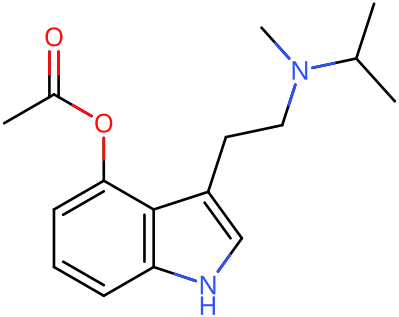
4-AcO-MiPT Stats & Data
CIDMXLOVFPIHDS-UHFFFAOYSA-NReceptor Profile
Receptor Actions
History & Culture
4-AcO-MiPT is a synthetic psychedelic tryptamine that remains relatively obscure within the broader landscape of psychoactive substances. Unlike many classical psychedelics with decades of documented use, this compound has accumulated very little history of human consumption and minimal scientific literature regarding its effects in humans. The substance emerged as part of the broader wave of novel tryptamine derivatives that became available through online research chemical vendors in the early 2000s. While analytical methods have been developed for its detection in forensic and research contexts, comprehensive pharmacological studies remain lacking. Today, 4-AcO-MiPT is primarily acquired through grey market vendors and is used either recreationally or as an entheogenic tool by a small community of psychedelic enthusiasts.
Toxicity
PsychonautWikiThe toxicity and long-term health effects of recreational 4-AcO-MiPT use do not seem to have been studied in any scientific context and the exact toxic dose is unknown. This is because 4-AcO-MiPT is a research chemical with very little history of human usage. Anecdotal evidence suggests that there are no negative health effects attributed to simply trying the drug by itself at low to moderate doses and using it very sparingly (but nothing can be completely guaranteed). Independent research should always be done to ensure that a combination of two or more substances is safe before consumption. It is strongly recommended that one use harm reduction practices when using this drug.
Effect Profile
Curated + 1 ReportsStrong visuals, headspace, and auditory effects with low body load
Strong sensory enhancement with mild stimulation, low euphoria
Duration Timeline
BluelightTolerance & Pharmacokinetics
drugs.wikiTolerance Decay
Cross-Tolerances
Experience Report Analysis
ErowidDemographics
Gender Distribution
Too few reports for a chart: gender is known from 3 reports, and a split is drawn only from 20 reports or more. Counts are shown instead. Why 20?
- Male 3 of 3
Age Distribution
Reports Over Time
Real-World Dose Distribution
ErowidFrom 37 of 37 recorded dose entries: those that state a weight (mg, g or µg), in routes with at least five of them. Values above Q3 + 3×IQR, far above what people typically take, are left out; they can include real heavy doses and overdoses, not only mistakes.
Oral (n=35)
Legal Status
| Country | Status | Notes |
|---|---|---|
| Finland | Illegal | Banned in December 2014 as part of a government regulation prohibiting over 100 psychoactive substances with no accepted medical use. |
| Germany | NpSG (Controlled) | Controlled under the Neue-psychoaktive-Stoffe-Gesetz (New Psychoactive Substances Act) since July 18, 2019. Production, import with intent to market, administration to others, and trading are criminal offenses. Possession is prohibited but not subject to criminal penalties. Ordering may be considered incitement to place on the market. |
| Japan | Controlled Substance | Designated as a controlled substance effective March 25, 2015 under Japanese drug control legislation. |
| Sweden | Illegal (Health Hazard) | Classified as a health hazard under the Lagen om förbud mot vissa hälsofarliga varor (Act on the Prohibition of Certain Goods Dangerous to Health) since November 1, 2005. Listed in regulation SFS 2005:733, making both possession and sale illegal. |
| Switzerland | Potentially Illegal | May be considered illegal under Buchstabe B of Swiss drug legislation as an ester analogue of 4-HO-MiPT, which is a controlled substance. Legal status depends on analogue interpretation. |
| United Kingdom | Class A | Controlled as a Class A substance because it is an ester of 4-HO-MiPT, which falls under the tryptamine catch-all clause of the Misuse of Drugs Act 1971. Class A carries the most severe penalties under UK law. |
| United States | Unscheduled (Federal Analogue Act may apply) | Not specifically scheduled under the Controlled Substances Act. However, it may be considered an analogue of psilocin (4-HO-DMT), a Schedule I substance. Sale for human consumption or possession with intent to ingest could potentially be prosecuted under the Federal Analogue Act, though no such prosecutions have been documented. |