
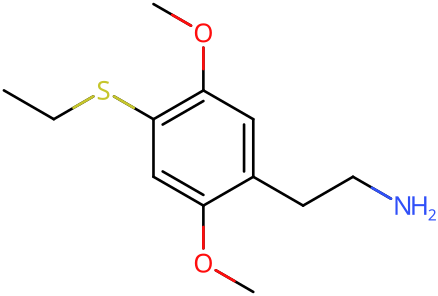
2C-T-2 Stats & Data
NCCc1cc(OC)c(SCC)cc1OCHCWQGDLBIKOJPM-UHFFFAOYSA-NReceptor Profile
Receptor Actions
History & Culture
1981–present
2C-T-2 was first synthesized by Alexander Shulgin in 1981. That same year, Shulgin discovered its psychedelic properties through self-experimentation, establishing the compound's activity in humans.
1990–1991
The compound was first described in the scientific literature by psychedelic psychotherapy pioneer Myron J. Stolaroff in 1990. Stolaroff conducted a formal study evaluating 2C-T-2's potential use in psychotherapy based on the experiences of forty participants. He compared the effects favorably to MDMA, describing 2C-T-2 as more emotionally opening and permitting a wider exploration of feelings and thoughts. Subsequently, Shulgin and colleagues published a more detailed description in 1991, and the compound was featured prominently in Shulgin's book PiHKAL (Phenethylamines I Have Known and Loved) that same year.
2C-T-2 holds a notable place in psychedelic chemistry as one of the so-called "magical half-dozen," Shulgin's self-rated most important phenethylamine compounds. All compounds in this group except mescaline were developed and synthesized by Shulgin himself. The magical half-dozen comprises mescaline, DOM, 2C-B, 2C-E, 2C-T-2, and 2C-T-7.
1990s–present
Following the publication of PiHKAL, 2C-T-2 emerged as a novel designer drug during the 1990s. A point of potential misidentification exists regarding the compound's naming. 2C-T-2 has occasionally been abbreviated simply as "T-2," a nickname also used for T-2 Toxin, a mycotoxin of the Tricothecene group formed mainly by Fusarium species. T-2 Toxin gained notoriety as an alleged chemical warfare agent in Southeast Asia, though it was later identified as bee feces rather than a Soviet military weapon. Despite the shared nickname, T-2 Toxin and 2C-T-2 are radically different compounds.
Subjective Effects
Physical
- Spontaneous tactile sensations: The body high of 2C-T-2 can be described as very intense and uncomfortable in comparison to 2C-E or 2C-B. In high doses, it's capable of causing painful cramping. It is similar yet distinct from the body high experienced on 2C-T-7, but is considered much more unpleasant. The sensation itself can be described as intense and may manifest itself in the form of a continuously shifting tingling sensation that travels up and down the body in spontaneous waves.
- Stimulation: In terms of its effects on the physical energy levels of the tripper, 2C-T-2 is usually considered to be very energetic and stimulating in a fashion that is quite comparable to that of other phenethylamines such as 2C-B, 2C-E and 2C-P.
- Bodily control enhancement: Although this component is capable of manifesting itself in a distinct and noticeable fashion for most users, it does not generally seem to be as apparent or intense as the same component found within LSD and 2C-B.
- Tactile enhancement
- Nausea: Extreme nausea is commonly reported when consumed in moderate to high dosages and either passes once the tripper has vomited or gradually fades by itself as the peak sets in. It can be described as very painful and violent in comparison to 2C-T-7 or 2C-E.
- Stomach cramps
- Vasoconstriction
- Temperature regulation loss
Cognitive
The head space of 2C-T-2 is described by many as one which is both insightful and relatively normal in its thought processes even at moderate to high dosages.
- Current mind state enhancement
- Thought acceleration
- Feelings of fascination, importance and awe
- Time distortion
- Analysis enhancement: This effect is consistent in its manifestation and is outrospection dominant.
- Personal bias suppression
- Conceptual thinking
- Ego suppression, loss and death
- Thought loops
- Feelings of interdependent opposites
- Delusions
- Unity and interconnectedness
Sensory
- Enhancements
- Distortions
- Hallucinations
- Visual drifting: (Melting, Flowing, Breathing and Morphing) - In comparison to other psychedelics, this effect can be described as highly detailed, slow and smooth in motion, static in appearance and extremely realistic in style but with a subtle digital/cartoonish form.
- Tracers
- After images
- Symmetrical texture repetition
- Colour shifting
- Scenery slicing
- Visual acuity enhancement
- Colour enhancement
- Pattern recognition enhancement
2C-T-2 produces a full range of high level hallucinatory states in a fashion that is more consistent and reproducible than that of many other commonly used psychedelics, particularly in comparison to other substances within the phenethylamine family.
- Transformations
- External hallucinations: In comparison to other psychedelics such as ayahuasca, 2C-T-2 is very high in external hallucinations. This particular effect commonly contains hallucinations with scenarios, settings, concepts and autonomous entity contact manifested as dense solidified geometric matter or physical objects of imagined concepts. They are more common within dark environments and can be described as external in their manifestation, lucid in believability, interactive in style and almost exclusively of religious, spiritual, mystical or transcendental nature in their overall theme.
- Internal hallucinations: In comparison to other psychedelics such as LSD, 2C-T-2 is very high in hallucinations embedded within visual geometry. This particular effect commonly contains hallucinations with scenarios, settings, concepts and autonomous entity contact. They are more common within dark environments and can be described as internal in their manifestation, lucid in believability, interactive in style and almost exclusively of religious, spiritual, mystical or transcendental nature in their overall theme.
Forked from Subjective Effect Documentation by Josie Kins, November 2014. Via dose.wiki (CC0).
Toxicity
PsychonautWikiThe toxicity and long-term health effects of recreational 2C-T-2 use do not seem to have been studied in any scientific context and the exact toxic dosage is unknown. Anecdotal reports suggest that there are no negative health effects attributed to trying this drug, but nothing can be completely guaranteed. It is strongly recommended that one use harm reduction practices when using this substance.
Addiction & dependence
2C-T-2 is not habit-forming, and the desire to use it can actually decrease with use. It is most often self-regulating. Tolerance to the effects of 2C-T-2 is built almost immediately after ingestion.
Effect Profile
Curated + 107 ReportsStrong visuals, headspace, and auditory effects with strong body load
Strong stimulation, sensory enhancement, and euphoria with moderate empathy
Duration Timeline
BluelightTolerance & Pharmacokinetics
drugs.wikiTolerance Decay
Rapid acute tachyphylaxis within the same session; cross-tolerance expected across serotonergic psychedelics. Data are mostly anecdotal across 2C‑x; spacing 7–14 days is commonly advised to reset.
Cross-Tolerances
Demographics
Gender Distribution
Age Distribution
Reports Over Time
Effect Analysis
Erowid + BluelightEffects aggregated from 107 experience reports (67 single-substance Erowid + 40 Bluelight)
Effect Sentiment Distribution
Confidence Distribution
Each bar is the share of reports mentioning the effect; its whisker, and the band on the rows below, is the 95% interval: where the share could plausibly be with other reports of the same kind.
Positive Effects 71
Adverse Effects 47
Show 27 more adverse effects
Show 23 neutral or unclassified mentions
Also reported in combinations. In the 81 2C-T-2 reports where another drug was taken too, 6 (7.4%) mention hospital, emergency services or an overdose, 1 (1.2%) a seizure and 4 (4.9%) psychosis. In the 67 single-substance reports: 6.0%, 1.5% and 3.0%. These are not in the figures above: they cannot be put down to 2C-T-2 alone, and a mention is not always something that happened to the writer.
Dose-Response Correlation
How effect frequency changes across dose levels. Whiskers, and the numbers' hover text, give each figure's 95% interval.
Not drawn, too few reports (a dose tier needs 20): Oral Light (n=10). Why 20?
Subjective Effect Ontology
Experience ReportsStructured effect tags extracted from 188 Erowid & Bluelight experience reports using a controlled vocabulary of 220+ canonical effects across 15 domains.
Visual
Dosage Distribution
Dose distribution from experience reports, one dose per report (the first listed). Doses above Q3 + 3×IQR, far above what people typically take, are left out of the median and range and listed under each route: most are real heavy doses or overdoses, not mistakes.
Oral
1 report gave a dose above the typical range (150 mg), so it is not in the figures above. It mentions hospital, emergency services or an overdose. Listing a dose here does not mean it is safe.
1 dose more than 50 times the median may be a typing or unit error and is not in the figures either: check the report.
Insufflated
Real-World Dose Distribution
ErowidFrom 171 of 192 recorded dose entries: those that state a weight (mg, g or µg), in routes with at least five of them. Values above Q3 + 3×IQR, far above what people typically take, are left out; they can include real heavy doses and overdoses, not only mistakes.
Insufflated (n=32)
Oral (n=136)
Common Combinations
Most co-occurring substances, as a share of all 148 reports filed under 2C-T-2; whiskers are 95% intervals
Form / Preparation
Most common forms and preparations, as a share of the 116 reports that give one; whiskers are 95% intervals
Body-Weight Dosing
Dose per kg of body weight, one dose per report (the first listed), from reports giving a weight of 30–250 kg. Doses above Q3 + 3×IQR, far above what people typically take, are left out of the median and range and listed under each route.
Oral
1 report gave a dose above the typical range (2.308 mg/kg), so it is not in the figures above. It mentions hospital, emergency services or an overdose. Listing a dose here does not mean it is safe.
1 dose more than 50 times the median may be a typing or unit error and is not in the figures either: check the report.
Show the reports
- 2.308 mg/kg · mentions hospital, emergency services or an overdose
Possibly a typing or unit error:
- 334.225 mg/kg · another drug taken too
Insufflated
Unknown
Redose Patterns
Redosing behavior across 120 reports
Legal Status
| Country | Status | Notes |
|---|---|---|
| Argentina | Controlled substance | Listed as a controlled substance alongside other phenethylamines including 2C-B and 2C-I. |
| Australia | Schedule 9 | Classified as a prohibited substance under the Poisons Standard since 2005. Schedule 9 substances are those which may be abused or misused and are prohibited except for approved medical or scientific research, analytical, teaching, or training purposes with government authorization. |
| Austria | Illegal (SMG) | Prohibited under the Suchtmittelgesetz (Narcotics Act). Possession, production, and sale are illegal. |
| Belgium | Illegal | Added to the list of controlled psychotropic substances on November 8, 2004. |
| Brazil | Illegal | Controlled as of February 18, 2014. Listed on Portaria SVS/MS nº 344, making possession, production, and sale illegal. |
| Canada | Schedule III (CDSA) | Controlled under the Controlled Drugs and Substances Act as of October 31, 2016. Classified as a derivative of 2,5-dimethoxyphenethylamine. |
| China | Controlled substance | Added to the list of controlled substances as of October 2015. |
| Denmark | Category B | Added to Category B of the controlled substances list on August 23, 2003. |
| Estonia | Schedule I | Added to Schedule I in February 2011 alongside several other phenethylamines and synthetic cannabinoids. |
| Finland | Narcotic drug | Classified as a narcotic substance under Finnish drug control legislation. |
| Germany | Anlage I BtMG | Listed in Anlage I (Schedule I) of the Betäubungsmittelgesetz (Narcotics Act) since October 1998. Represents the highest level of control; manufacturing, possession, import, export, purchase, sale, procurement, and dispensing without license are prohibited. |
| Italy | Tabella I | Added to Tabella I (the list of prohibited plants and substances) by Ministry of Health statement on January 11, 2005. |
| Japan | Designated Substance (Shitei-Yakubutsu) | Controlled under the Pharmaceutical Affairs Law. Possession and sale are illegal. |
| Latvia | Schedule I | Listed as a Schedule I controlled substance under national drug legislation. |
| Netherlands | List I (Opiumwet) | The Netherlands was the first country to ban 2C-T-2, classifying it as a hard drug under List I of the Opium Law in April 1999. Unlicensed manufacture, sale, import, trade, and possession can be prosecuted. |
| Portugal | Controlled substance | Law enacted in January 2005 to control 2C-T-2, 2C-I, 2C-T-7, and TMA-2. |
| Slovakia | Grade 2 | Added to Grade 2 (equivalent to Schedule II under the 1971 UN Convention on Psychotropic Substances) in October 2009. |
| Sweden | Schedule I (Narcotic) | First regulated on April 1, 1999 under the Act on the Prohibition of Certain Goods Dangerous to Health (SFS 1999:58), making sale and possession illegal. Subsequently added to Schedule I of the Narcotic Drugs Punishments Act on March 16, 2004, as published in MPA regulation LVFS 2004:3. |
| Switzerland | Controlled (Verzeichnis D) | Specifically named as a controlled substance under Verzeichnis D of the Swiss narcotics legislation. |
| United Kingdom | Class A | Controlled as a Class A substance under the Misuse of Drugs Act 1971 through the phenethylamine catch-all clause. All compounds featured in PiHKAL are prohibited. Class A carries the most severe penalties for possession, manufacture, and import. |
| United States | Schedule I | Federally scheduled under SEC. 1152 of the Food and Drug Administration Safety and Innovation Act of 2012 (S.3187), signed into law in July 2012. Possession, manufacture, and import are illegal. Additional state-level controls exist in Alabama (February 2013), Louisiana (June 2013), Oklahoma (May 2011), Pennsylvania, and Vermont (July 2012). |
Harm Reduction
drugs.wikiAllergy-test and dose accurately: Because active doses are in the low tens of milligrams, always use a 0.001 g (milligram) scale and allergy test 1–2 mg before a first full dose; start low and wait at least 3 hours before considering any change to avoid stacking a delayed onset. Misrepresentation risk is real: pressed “2C‑B” or “mescaline” tablets and powders occasionally contain other phenethylamines; use multiple reagents and, where possible, a drug-checking lab (Energy Control/TEDI-type services) to confirm identity before dosing. Reagents: On Marquis, 2C‑T‑2 typically shows a salmon/orange‑to‑red reaction, contrasting with 2C‑B’s green; no single reagent can confirm identity—use at least Marquis, Mecke, and Froehde and interpret within ~60 seconds. Avoid nasal use: Insufflation produces a very rapid, intense come‑up and is consistently reported to cause severe burning, higher nausea/vomiting rates, and vasoconstriction; 2C‑T‑x intranasal use has been linked to serious toxicity and deaths (notably with 2C‑T‑7). Hydration and heat: Like many psychedelics with mild stimulation, overheating can occur in hot, crowded settings; take breaks to cool down and sip fluids slowly (about 500 mL per hour maximum) to avoid both dehydration and over‑hydration. Redosing and tolerance: Acute tolerance develops rapidly; redosing late in the experience adds side‑effects more than benefits. Leave at least a week between substantial psychedelic sessions to reduce tolerance and mental fatigue. Set/setting and support: Anxiety and body‑load are common at the peak; a trusted sober sitter, calm environment, and controlled sensory input reduce risk of panic and injury. Emergency response: If severe agitation, hyperthermia, or signs of serotonin toxicity occur (high fever, clonus, confusion), seek medical care; lay responders should focus on cooling, reassurance, and avoiding restraints that impair breathing—do not attempt to self‑medicate. Rectal route hygiene: If using rectal administration to reduce nausea, dissolve in sterile water, use clean applicators, and lubricant to minimize mucosal injury and infection risk. Drug checking and ID nuance: 2C‑T‑2 may be sold in capsules or powders; while 2C‑B is often in pressed tablets, both can be confused at point‑of‑sale; lab testing best differentiates them; reagent patterns aid but are not definitive. Legal & sourcing context: EU risk assessment concluded 2C‑T‑2 is a potent hallucinogen with no recognized medical use; many regions control it; legal risk adds to harm if medical help is delayed—carry accurate substance/dose info for responders.
References
Data Sources
Cited References
- Bluelight: Big & Dandy 2C-T-2 Thread
- ChemSpider: 2C-T-2 Chemical Structure
- EMCDDA Risk Assessment: 2C-T-2
- Erowid: 2C-T-2 Basics
- Leysen et al. 2004 - 5-HT2 Receptor Binding Affinities
- PIHKAL Entry #40: 2C-T-2
- Reddit: field report – first-hand 20 mg oral experience
- 5-HT2 receptor binding affinities (Leysen et al. 2004)
Additional references
- PIHKAL entry #40 2C‑T‑2 (dosage & duration)
- Erowid 2C‑T‑2 Vault (general info, history, links)
- EMCDDA/ EUDA – Report on the risk assessment of 2C‑I, 2C‑T‑2, 2C‑T‑7 (2004)
- EU Council Decision 2003/847/JHA (control measures for 2C‑I/2C‑T‑2/2C‑T‑7/TMA‑2)
- TripSit Drug Combinations (2C‑x / 2C‑T‑x with MAOIs, stimulants, tramadol, etc.)
- Erowid – MDMA Testing Kit FAQ (Marquis reagent color table incl. 2C‑T‑2)
- Erowid – 2C‑T‑7 Dosage & Death Warnings (to contextualize nasal-route risk across 2C‑T‑x)
- Erowid – 2C‑T‑7 fatality case summary (insufflated 35 mg)
- Bluelight community reports on 2C‑T‑2 nasal burn/adverse effects
- Bluelight – user notes vomiting after insufflated 2C‑T‑2 (contextual anecdote)
- DrugWise – Ecstasy harm reduction (cooling, fluid intake guidance)
- Saferparty.ch – 2C‑B alerts (misidentification risk with pressed tablets)
- Saferparty.ch – 2C‑B pill with impurities (illustrative of mixed contents)
- Erowid newsletter – on misidentified pills and testing (Energy Control/TLC)