
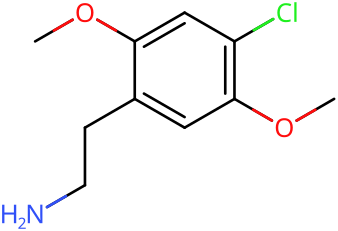
2C-C Stats & Data
COC1=CC(=C(C=C1CCN)OC)ClCGKQFIWIPSIVAS-UHFFFAOYSA-NReceptor Profile
Receptor Actions
History & Culture
2C-C was first synthesized in 1983 by Alice C. Cheng and Neal Castagnoli Jr. at the University of California, San Francisco. The compound was not originally created for its psychoactive properties; rather, it was produced as an intermediate during their investigation of 6-hydroxydopamine analogs and their potential neurotoxicity. Their work was published in the scientific literature in 1984, though the compound's effects in humans remained unexplored at that time. The psychoactive properties of 2C-C were later investigated and documented by Alexander Shulgin, who included a detailed entry in his 1991 book PiHKAL (Phenethylamines I Have Known and Loved). Shulgin's documentation reported an oral dosage range of 20 to 40 milligrams with a duration of 4 to 8 hours, providing the first systematic account of the substance's effects in humans. Following its documentation in PiHKAL, 2C-C remained relatively obscure until the 2000s when experience reports began appearing on online drug discussion forums. The substance has since been used recreationally and as an entheogen, though it remains uncommon compared to other members of the 2C-x family. It is rarely encountered on the street and has been primarily obtained as a grey area research chemical through online vendors. In 2005, the compound was first detected in Taiwan's drug supply. Analysis of the controlled drug market during the 2010s found 2C-C appearing as an occasional adulterant; in one study of 173 samples, 2C-C was detected only once, found alongside 25C-NBOMe in a sample sold as LSD.
Subjective Effects
Physical
- Spontaneous tactile sensations: The body high of 2C-C can be described as a pleasurable, warm, soft, all-encompassing and mild tingling sensation. This maintains a consistent presence that steadily rises with the onset and hits its limit once the peak has been reached.
- Stimulation: In terms of its effects on the physical energy levels of the tripper, the 2C-C experience begins with mild stimulation, but usually becomes very sedating as the experience progresses and lacks the distinctive energetic feeling associated with most phenethylamines. This feeling was accurately described in Alexander Shulgin's PiHKAL as 'an intense form of relaxation.'
- Sedation
- Nausea: Although nausea remains present, in comparison to other phenethylamines such as 2C-E, 2C-I or 2C-B, this remains extremely mild and dissipates quickly even with higher dosages. It is perhaps one of the most physically underwhelming psychedelics for this reason alone.
- Bodily control enhancement: Whilst at lower doses one may find that their bodily control is enhanced, at higher dosages it seems to become suppressed.
- Motor control loss
- Tactile enhancement
- Temperature regulation loss
- Increased salivation
- Increased heart rate
Cognitive
The head space of 2C-C is described by many as one which is both insightful and relatively normal in its thought processes even at moderate to high dosages.
- Analysis enhancement
- Empathy, love and sociability enhancement: This component is consistently manifested only in the context of social settings in which one is within the company of others. These feelings of sociability, love and empathy are a little weaker and less sharp than those found on substances such as MDMA and 2C-B. They primarily manifest during the stimulating onset of the experience and dissipate once the full extent of the trip takes place.
- Thought acceleration
- Time distortion
- Novelty enhancement
- Sexual arousal
- Conceptual thinking
- Thought connectivity
- Current mind state enhancement
- Personal bias suppression
- Memory suppression
- Unity and interconnectedness
Sensory
- Enhancements
- Distortions
- Hallucinations
- Visual drifting: (Melting, Flowing, Breathing and Morphing) - In comparison to other psychedelics, this effect can be described as highly detailed, slow and smooth in motion, static in appearance and realistic in style.
- Tracers
- Colour shifting
- Visual acuity enhancement
- Colour enhancement
- Pattern recognition enhancement
2C-C produces a full range of high level hallucinatory states in a fashion that is more consistent and reproducible than that of many other commonly used psychedelics, particularly in comparison to other substances within the phenethylamine family.
- Transformations
- Internal hallucinations: In comparison to other psychedelics such as LSD, 2C-C is extremely high in hallucinations embedded within visual geometry. This particular effect commonly contains hallucinations with scenarios, settings, concepts and autonomous entity contact. They are more common within dark environments and can be described as internal in their manifestation, lucid in believability, interactive in style and almost exclusively of religious, spiritual, mystical or transcendental nature in their overall theme.
- External hallucinations: 2C-C is capable of external hallucinations embedded within visual geometry. This particular effect commonly contains hallucinations with scenarios, settings, concepts and autonomous entity contact. They can be described as external in their manifestation, lucid in believability, interactive in style and almost exclusively of religious, spiritual, mystical or transcendental nature in their overall theme.
- Machinescapes
Forked from Subjective Effect Documentation by Josie Kins, January 2015. Via dose.wiki (CC0).
Toxicity
PsychonautWikiThe toxicity and long-term health effects of recreational 2C-C use do not appear to have been studied in any scientific context and the exact toxic dose is unknown. This is because 2C-C is a research chemical with a limited history of human use. Anecdotal reports from those who have tried this compound suggest that there are no negative health effects attributed to simply trying the substance by itself at low to moderate doses and using it very sparingly (although nothing can be completely guaranteed). Independent research should always be conducted to ensure that a combination of two or more substances is safe before consumption. It is strongly recommended that one use harm reduction practices when using this substance.
Effect Profile
Curated + 85 ReportsStrong visuals, headspace, and auditory effects with strong body load
Strong stimulation with strong anxiety/jitters, moderate euphoria, mild focus
Duration Timeline
BluelightTolerance & Pharmacokinetics
drugs.wikiTolerance Decay
General psychedelic tolerance pattern: rapid tolerance after a single session, partial decay in ~3 days, near‑baseline by ~1–2 weeks for most users. Data are largely anecdotal by extrapolation from 2C‑B, mescaline, and class‑wide sources.
Cross-Tolerances
Demographics
Gender Distribution
Age Distribution
Reports Over Time
Effect Analysis
Erowid + BluelightEffects aggregated from 85 experience reports (49 single-substance Erowid + 36 Bluelight)
Effect Sentiment Distribution
Confidence Distribution
Each bar is the share of reports mentioning the effect; its whisker, and the band on the rows below, is the 95% interval: where the share could plausibly be with other reports of the same kind.
Positive Effects 73
Adverse Effects 41
Show 21 more adverse effects
Show 22 neutral or unclassified mentions
Also reported in combinations. In the 50 2C-C reports where another drug was taken too, 3 (6.0%) mention hospital, emergency services or an overdose, 0 (0.0%) a seizure and 0 (0.0%) psychosis. In the 49 single-substance reports: 8.2%, 0.0% and 0.0%. These are not in the figures above: they cannot be put down to 2C-C alone, and a mention is not always something that happened to the writer.
Dose-Response Correlation
How effect frequency changes across dose levels. Whiskers, and the numbers' hover text, give each figure's 95% interval.
Not drawn, too few reports (a dose tier needs 20): Oral Strong (n=11). Why 20?
Dosage Distribution
Dose distribution from experience reports, one dose per report (the first listed). Doses above Q3 + 3×IQR, far above what people typically take, are left out of the median and range and listed under each route: most are real heavy doses or overdoses, not mistakes.
1 report gave a dose above the typical range (100 mg), so it is not in the figures above. It mentions hospital, emergency services or an overdose. Listing a dose here does not mean it is safe.
Show the report
- 100 mg · mentions hospital, emergency services or an overdose
Real-World Dose Distribution
ErowidFrom 132 of 140 recorded dose entries: those that state a weight (mg, g or µg), in routes with at least five of them. Values above Q3 + 3×IQR, far above what people typically take, are left out; they can include real heavy doses and overdoses, not only mistakes.
Intramuscular (n=5)
Oral (n=98)
Insufflated (n=21)
Rectal (n=6)
Common Combinations
Most co-occurring substances, as a share of all 99 reports filed under 2C-C; whiskers are 95% intervals
Form / Preparation
Most common forms and preparations, as a share of the 74 reports that give one; whiskers are 95% intervals
Body-Weight Dosing
Dose per kg of body weight, one dose per report (the first listed), from reports giving a weight of 30–250 kg. Doses above Q3 + 3×IQR, far above what people typically take, are left out of the median and range and listed under each route.
Oral
Insufflated
Redose Patterns
Redosing behavior across 80 reports
Legal Status
| Country | Status | Notes |
|---|---|---|
| Australia | Illegal (blanket ban) | Prohibited under a blanket ban covering all substituted phenethylamines, including the entire 2C-X family. |
| Austria | Illegal (NPSG) | Controlled under the Neue-Psychoaktive-Substanzen-Gesetz (New Psychoactive Substances Act). The NPSV implementing regulation explicitly prohibits all substituted phenethylamines under Schedule II. |
| Brazil | Controlled | Listed on Portaria SVS/MS nº 344 since February 18, 2014. Possession, production, and sale are prohibited. |
| Canada | Schedule III (CDSA) | Controlled under the Controlled Drugs and Substances Act as of October 31, 2016, classified as a derivative of 2,5-dimethoxyphenethylamine. |
| China | Controlled | Added to China's list of controlled substances in October 2015. |
| Denmark | Uncontrolled | Not listed as a controlled substance under Danish law as of available information. |
| Finland | Controlled | Prohibited under a December 2014 government decree on psychoactive substances banned from the consumer market. |
| Germany | Anlage I BtMG | Listed in Schedule I of the Betäubungsmittelgesetz (Narcotics Act) since December 13, 2014. Manufacturing, possession, import, export, purchase, sale, procurement, and dispensing require a license. |
| Israel | Controlled | Added to Israel's list of controlled substances in December 2008. Purchase, sale, and possession are illegal. |
| Japan | Designated Substance (Shitei-Yakubutsu) | Controlled under the Pharmaceutical Affairs Law as a designated substance. Possession and sale are prohibited. |
| Latvia | Schedule I | Classified as a Schedule I controlled substance under Latvian drug legislation. |
| Sweden | Controlled (health hazard) | Classified as a health hazard since March 1, 2005 under regulation SFS 2005:26, pursuant to the Act on the Prohibition of Certain Goods Dangerous to Health (Lagen om förbud mot vissa hälsofarliga varor). Sale and possession are prohibited. |
| Switzerland | Controlled (Verzeichnis E) | Specifically named as a controlled substance under Verzeichnis E of Swiss narcotics legislation. |
| Turkey | Controlled | Classified as a drug under Turkish law. Possession, production, supply, and import are prohibited. |
| United Kingdom | Class A | Controlled under the Misuse of Drugs Act 1971 via the phenethylamine catch-all clause. Class A substances carry the most severe penalties under UK drug law. |
| United States | Schedule I | Federally controlled under the Controlled Substances Act since July 9, 2012, pursuant to the Food and Drug Administration Safety and Innovation Act. Possession, distribution, and manufacture are illegal without DEA authorization. Additionally scheduled at state level in Alabama (Schedule I since February 2013), Oklahoma (Schedule I since May 2011), Pennsylvania (Schedule I), and Vermont (classified under hallucinogenic drugs since July 2012). |
Harm Reduction
drugs.wikiOnset may be delayed up to ~2 hours orally; avoid redosing early to prevent accidental overintoxication. Intranasal administration is frequently described as extremely painful with notable mucosal irritation and offers little safety advantage over oral routes while increasing the risk of rapid-onset anxiety or dysphoria. Always test unknown powders or pressed tablets with multiple reagents and, where available, use laboratory drug checking; 2C‑x tablets and powders have been found with synth impurities or misidentified contents. NBOMe compounds can be sold or confused as 2C‑x; they are active at sub‑milligram doses and have caused severe vasoconstriction and seizures—do not assume blotters or unusually potent materials are 2C‑C. Mixing serotonergic psychedelics with lithium has repeatedly been linked to seizures and life‑threatening reactions; this warning generalizes beyond LSD to serotonergic compounds, and several 2C‑x + lithium cases exist—avoid entirely. MAOIs can unpredictably potentiate phenethylamines and are best avoided; tramadol lowers seizure threshold and is dangerous with psychedelics. Stimulant combinations (e.g., amphetamines, cocaine) raise cardiovascular strain and anxiety; avoid. SSRIs/SNRIs commonly blunt psychedelic effects and make dose predictability poor; use caution and do not compensate by redosing high. For accurate dosing, use a calibrated 0.001 g scale and consider volumetric dosing for low or highly sensitive ranges; cheap pocket scales are often inaccurate below ~10–20 mg. Cross‑tolerance with other classic psychedelics is expected; waiting at least a week (preferably 2) between sessions reduces tolerance and psychological hangover. Set, setting, and trip‑sitter/plan matter; avoid driving and high‑risk activities until fully baseline.
References
Data Sources
Cited References
- Asanuma et al., 2020 - Neurotoxicity of 2C Series
- Bluelight: 2C-C Live Report
- Dean et al., 2013 - 2C or Not 2C Review
- Eshleman et al., 2014 - Behavioral & Neurochemical Pharmacology
- Kim et al., 2021 - Neurotoxicity in Rodents
- Nervewing: Trip Report - 2C-C (Intranasal)
- Nichols D., 2016 - Pharmacology of Psychedelics
- Papaseit et al., 2018 - Acute Effects of 2C-B in Humans
- PIHKAL 2C-C Entry
- Reddit 2C-C: The Sober Psychedelic
- Scarfone et al., 2025 - Toxicodynamic Insights of 2C & NBOMe Drugs
- Talk to Frank: 2C Family Drug Facts
- Kim et al., 2021 – Neurotoxicity in Rodents
- Vang et al., 2013 – “2C or Not 2C” Review
- Scarfone et al., 2025 – Toxicodynamic Insights of 2C & NBOMe Drugs
- Nichols D., 2016 – Pharmacology of Psychedelics
- Papaseit et al., 2018 – Acute Effects of 2C-B in Humans
- FRANK – Mixing Risks Section
Additional references
- Erowid 2C‑C Effects (duration table)
- Erowid 2C‑C Dose
- PIHKAL #22 2C‑C (dose, duration, qualitative notes)
- Effect Index – 2C‑C trip reports (oral and intranasal)
- TripSit – Drug combinations (2C‑x and general cautions)
- TripSit – Psychedelics (tolerance guidance)
- Erowid LSD Interactions (Lithium warning – seizures/death case reports)
- Erowid Experience Vaults – Lithium combinations (multiple psychedelic + lithium seizure reports)
- Erowid 25C‑NBOMe Vault (misidentification risk, vasoconstriction/seizures)
- Erowid 25C‑NBOMe Effects (vasoconstriction and adverse events)
- saferparty.ch – 2C‑C tablet with synth impurities (Drug Checking warning)
- Drug Users Bible – safer dosing, mg scales, volumetric dosing overview
- TripSit – Scales (accuracy caveats; volumetric dosing link)
- Erowid 2C‑B Basics (short-term tolerance pattern; class‑adjacent extrapolation)
- PubChem – 2,5-Dimethoxy-4-chlorophenethylamine (identifiers/nomenclature)