
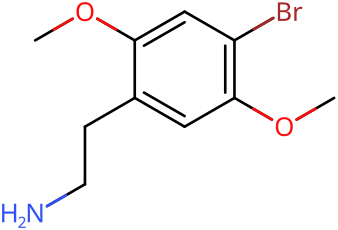
2C-B Stats & Data
COC1=CC(=C(C=C1CCN)OC)BrYMHOBZXQZVXHBM-UHFFFAOYSA-NPharmacology
DrugBankDescription
2C-B (4-bromo-2,5-dimethoxyphenethylamine) is a synthetic psychedelic substance derived from mescaline. It was invented in 1974 by a man named Alexander Shulgin — the godfather of MDMA and creator of the entire 2C- family of substances. Shulgin invented well over 200 psychoactive compounds in his research lab dubbed “The Farm.” Shulgin considered 2C-B to be one of his greatest creations. In one of his books — PiHKAL (phenethylamines I Have Known And Loved) — he listed 2C-B among his “magic half dozen”. The other five include mescaline, DOM, 2C-E, 2C-I, 2C-T2, and 2C-T7. The effects of 2C-B have been described as a combination between LSD and MDMA — but this is a simplification. In reality, the 2C-B experience is entirely unique. The qualities of 2C-B made it popular as a sex-enhancement drug in the 80s. The German pharmaceutical company Drittewelle started producing the drug under the name “Nexus.” It was sold in sex shops as a way to boost libido, sexual connection and increase stamina and energy. 2C-B is still considered by many to be the best psychedelic to use during sex of all time. In Shulgin’s own words, 2C-B “... is, in my opinion, one of the most graceful, erotic, sensual, introspective compounds I have ever invented.” 2C-B reached mainstream popularity sometime after 1985 when MDMA was officially banned. It was used as a legal alternative to MDMA. 2C-B and the rest of the 2C- family were later banned in 1995.
Receptor Profile
Receptor Actions
Measured Affinities
Guide to PHARMACOLOGYMeasured binding and functional data for 2C-B, curated by the IUPHAR/BPS Guide to PHARMACOLOGY. Each row cites the paper it came from. Lower concentrations mean tighter binding — a value in the sub-nanomolar range indicates a very potent interaction.
| Target | Action | Measure | Value | Concentration | Species | Source |
|---|---|---|---|---|---|---|
| 5-HT2A receptor HTR2A | Agonist | pKi | 9.18 | 0.661 nM | Human | PMID 16970404 |
Reading this. pKi, pEC50 and pIC50 are negative log molar values, so a higher number means a tighter interaction; the concentration column converts them for you. Values from non-human species are laboratory measurements and do not translate directly to human effect. Receptor affinity is not a dose — it describes what a molecule binds, not how much of it is safe to take.
Receptor data from the IUPHAR/BPS Guide to PHARMACOLOGY (v2026.2), licensed CC BY-SA 4.0. Matched to this substance by InChIKey.
History & Culture
1974–1975
2C-B was first synthesized in 1974 by American chemist Alexander Shulgin while investigating novel psychedelic compounds based on the chemical structure of mescaline, specifically exploring homologues of DOB. Its psychoactive properties were discovered on June 25, 1975, when Shulgin tested the compound on himself and described it as "beautifully active." He subsequently published his findings on 2C-B alongside those for 2C-D in the scientific literature that same year, proposing both compounds for potential use in psychedelic-assisted psychotherapy. Shulgin's comprehensive documentation of 2C-B was later included in his 1991 book PiHKAL (Phenethylamines I Have Known And Loved), where he listed it among the "magical half-dozen" psychedelic phenethylamines he considered most important. This distinguished group also included mescaline, DOM, 2C-E, 2C-T-2, and 2C-T-7. In subsequent interviews, Shulgin repeatedly identified 2C-B as his personal favorite psychedelic compound.
1970s–present
Following its discovery, 2C-B found its first applications among a small circle of American psychotherapists during the 1970s. These practitioners considered it one of the most suitable substances for therapeutic contexts due to its relatively short duration, mild side effect profile, and gentle overall character compared to other psychedelics. Therapists who employed 2C-B in clinical settings reported that it facilitated a warm, empathetic connection between practitioner and patient. They found that the substance helped break down ego defenses and inner resistances, allowing patients to access suppressed emotions and repressed memories. However, some accounts suggest that therapeutic use was eventually discontinued due to gastrointestinal side effects and the compound's lack of strong entactogenic properties compared to other options.
1985–1995
After MDMA was classified as a Schedule I substance in the United States in 1985, 2C-B emerged as a popular alternative in the recreational drug scene. It was first encountered as a novel designer drug in the United States that same year and gained traction in raves and club settings, where users appreciated its minimal comedown and clear, euphoric headspace. During the late 1980s and early 1990s, several companies legally manufactured and marketed 2C-B as an over-the-counter sexual enhancer. The German pharmaceutical company Drittewelle produced it under the brand name "Erox" for sale in adult stores and some nightclubs across European countries including Germany. In the Netherlands, it was sold in smart shops under the name "Nexus" as a legal ecstasy alternative. In Japan, it was marketed as "Performax" until the country scheduled the substance in the summer of 1998. The U.S. Drug Enforcement Administration reported its distribution in Miami in the form of yellow pills marketed as an aphrodisiac. The increasing popularity of 2C-B as both a recreational substance and commercial product led to regulatory action. It was placed in Schedule I in the United States in 1994, with permanent scheduling following in 1995. Most other countries enacted similar controls throughout the mid-1990s, and by 1999 it was illegal in most of the world. The compound was added to Schedule II of the UN Convention on Psychotropic Substances in March 2001. Despite these restrictions, interest in 2C-B resurged in the 2000s with the emergence of the research chemicals scene and the development of darknet markets.
1993–1996
2C-B was legally sold in Southern Africa from 1993 until early 1996, during which time it was adopted as an entheogen by traditional healers among the Sangoma, Nyanga, and Amagqirha peoples. The substance was marketed specifically as medicine for Sangomas under the name "Ubulawu Nomathotholo," which roughly translates to "Medicine of the Singing Ancestors." These practitioners reportedly used 2C-B in place of their traditional plant medicines during this period.
Subjective Effects
Physical
The physical effects of 2C-B can be broken down into five components all of which progressively intensify proportional to dosage.
- Spontaneous tactile sensations: The body high of 2C-B is not necessarily one of the most intense, but is instead one of the most complex compared to other psychedelics, sharing components of MDMA, 2C-E, and LSD. This is first characterized by an intense soft warm glow that grows over the body and is capable of becoming extremely physically euphoric. This is most similar to MDMA and is consistently manifested throughout the experience. This is contrasted by an intensely pleasurable yet sharp, cold electric tingling sensation which moves up and down the body. This is most similar to LSD and is also consistently manifested throughout the trip. The final physical effect noticed throughout the experience is an intense and slightly uncomfortable, energetic pins and needles sensation that manifests itself in the form of a continuously shifting and tingling sensation that travels up and down the body in spontaneous waves. This is most similar to 2C-E and is not entirely consistent throughout the trip.
- Stimulation: In terms of its effects on the physical energy levels of the tripper, 2C-B is usually considered to be very energetic and stimulating in a fashion that is quite comparable to that of MDMA.
- Increased bodily control
- Enhancement of touch
- Nausea: Mild to extreme nausea is reported when consumed in moderate to high dosages and either passes once the tripper has vomited or gradually fades by itself as the peak sets in.
Cognitive
The head space of 2C-B is described by many as one which is both insightful and relatively normal in its thought processes even at moderate to high dosages.
- Introspection: This component is consistently manifested only in the context of a non-social setting in which the user is alone.
- Increased empathy, love and sociability: These feelings of sociability, love and empathy are a little weaker and less sharp than those found on substances such as MDMA but still prove stronger and more consistent than other psychedelics of any class. This is capable of providing long lasting therapeutic effects.
- Sexual arousal
- Acceleration of thought
- Time distortion
- Feelings of fascination, importance and awe
- Conceptual thinking
- Connectivity of thought
- Enhancement of current mind state
- Removal of cultural filter
- Ego suppression, loss and death
Sensory
- Enhancements
- Distortions
- Hallucinations
- Visual drifting: (Melting, flowing, breathing and morphing) - In comparison to other psychedelics, this effect can be described as highly detailed, slow and smooth in motion, static in appearance, and unrealistic/cartoon-like in style.
- Tracers
- After images
- Texture repetition
- Colour shifting
- Scenery slicing
2C-B presents a full and complete array of possible visual enhancements.
- Increased visual acuity
- Enhancement of colours
- Enhanced pattern recognition
Like LSD, while 2C-B is capable of producing a full range of low and high level hallucinatory states, this is extremely rare and inconsistent at higher levels but common at lower levels.
- External hallucinations
- Internal hallucinations: Although 2C-B is technically capable of producing hallucinatory states in a fashion that is on par with psilocin or DMT in its vividness and intensity, in comparison, these effects are extremely rare and inconsistent. Whilst traditional psychedelics such as LSA, ayahuasca and mescaline will induce internal hallucinations near consistently at level 5 geometry and above, 2C-B will for most go straight into Level 7A visual geometry. This lack of consistently induced hallucinatory breakthroughs means that for most, 2C-B is simply not as deep of an experience as certain other psychedelics.
Forked from Subjective Effect Documentation by Josie Kins, September 2013. Via dose.wiki (CC0).
Toxicity
PsychonautWikiThe toxicity and long-term health effects of recreational 2C-B use have not been studied in any scientific context, and the exact toxic dose is unknown. Anecdotal evidence suggests that there are no negative health effects attributed to simply trying it by itself at low to moderate doses or using it very sparingly (although nothing can be completely guaranteed). It is strongly recommended that one use harm reduction practices when using this substance.
Addiction & dependence
As with other serotonergic psychedelic, 2C-B is considered to be non-addictive with a low potential for abuse. Tolerance to the effects of 2C-B is not built almost immediately after ingestion. There are many anecdotal reports of people ingesting this substance many days in a row (either consecutively or by redosing many many times in a row and tripping continuously for dozens of hours) with no immediate tolerance build up and still building quite slowly even under sustained exposure.
Organ-specific toxicity
2C-B at normal doses is unlikely to be neurotoxic. Through rough extrapolations of data from rat cortical cultures, the IC50 of neuronal activity may result from a dose of at least a 330-650mg. In other words, users should avoid a dose that large in order to avoid long term damage, but typical doses should be well within a safe range.
Effect Profile
Curated + 316 ReportsStrong visuals with moderate auditory effects, mild body load and headspace
User Experiences
Strong sensory enhancement with mild euphoria and stimulation, low empathy
User Experiences
Duration Timeline
BluelightEmpirical Duration
Erowid ReportsMedian times after the dose that Erowid reports state. A curve is drawn only when reports state all four points (onset, peak begins, comedown begins, back to baseline) and the medians fall in that order. No point is estimated from another.
Community Effects
TripSitTolerance & Pharmacokinetics
drugs.wikiTolerance Decay
Psychedelic tolerance is marked after one session and tends to return close to baseline within 1–2 weeks; spacing experiences by at least 2 weeks is common HR advice.
Cross-Tolerances
Demographics
Gender Distribution
Age Distribution
Reports Over Time
Effect Analysis
Erowid + BluelightEffects aggregated from 224 experience reports (174 single-substance Erowid + 142 Bluelight)
Effect Sentiment Distribution
Confidence Distribution
Each bar is the share of reports mentioning the effect; its whisker, and the band on the rows below, is the 95% interval: where the share could plausibly be with other reports of the same kind.
Positive Effects 73
Adverse Effects 47
Show 25 more adverse effects
Show 27 neutral or unclassified mentions
Also reported in combinations. In the 220 2C-B reports where another drug was taken too, 15 (6.8%) mention hospital, emergency services or an overdose, 6 (2.7%) a seizure and 13 (5.9%) psychosis. In the 174 single-substance reports: 8.6%, 1.7% and 2.3%. These are not in the figures above: they cannot be put down to 2C-B alone, and a mention is not always something that happened to the writer.
Dose-Response Correlation
How effect frequency changes across dose levels. Whiskers, and the numbers' hover text, give each figure's 95% interval.
Not drawn, too few reports (a dose tier needs 20): Oral Common (n=19), Insufflated Heavy (n=16). Why 20?
View data table
| Effect | Strong (n=22) |
|---|---|
| Visual Distortions | 86.4% (95% interval 67 to 95 percent) |
| Color Enhancement | 77.3% (95% interval 57 to 90 percent) |
| Music Enhancement | 63.6% (95% interval 43 to 80 percent) |
| Stimulation | 54.5% (95% interval 35 to 73 percent) |
| Anxiety | 54.5% (95% interval 35 to 73 percent) |
| Empathy | 50.0% (95% interval 31 to 69 percent) |
| Euphoria | 45.5% (95% interval 27 to 65 percent) |
| Nausea | 40.9% (95% interval 23 to 61 percent) |
| Closed-Eye Visuals | 36.4% (95% interval 20 to 57 percent) |
| Confusion | 36.4% (95% interval 20 to 57 percent) |
| Muscle Tension | 27.3% (95% interval 13 to 48 percent) |
| Sedation | 27.3% (95% interval 13 to 48 percent) |
| Introspection | 22.7% (95% interval 10 to 43 percent) |
| Auditory Effects | 22.7% (95% interval 10 to 43 percent) |
| Open-Eye Visuals | 18.2% (95% interval 7 to 38 percent) |
Subjective Effect Ontology
Experience ReportsStructured effect tags extracted from 444 Erowid & Bluelight experience reports using a controlled vocabulary of 220+ canonical effects across 15 domains.
Auditory
Cognitive
Emotional
Gastrointestinal
Motor
Tactile
Visual
Dose–Effect Mapping
Experience ReportsHow reported effects shift across dose tiers, based on 174 single-substance experience reports. The shaded band on each bar is its 95% interval. An arrow (↑ ↓) marks a change between the lowest and highest tier that count an effect only when the gap is bigger than chance would explain; ~ means no clear change. How changes are called
Not drawn, too few reports (a dose tier needs 20): Oral Common (n=19), Insufflated Heavy (n=16). Why 20?
Limited tier coverage — most reports fall within the Strong range. Effects at other dose levels may not be represented.
| Effect | Strong (n=22) | Change with dose |
|---|---|---|
| visual distortions | ||
| color enhancement | ||
| music enhancement | ||
| stimulation | ||
| anxiety | ||
| empathy | ||
| euphoria | ||
| nausea | ||
| closed-eye visuals | ||
| confusion | ||
| muscle tension | ||
| sedation | ||
| introspection | ||
| auditory effects | ||
| open-eye visuals | ||
| memory suppression | ||
| pupil dilation | ||
| body high | ||
| tactile enhancement | ||
| motor impairment |
Showing top 20 of 27 effects
Dosage Distribution
Dose distribution from experience reports, one dose per report (the first listed). Doses above Q3 + 3×IQR, far above what people typically take, are left out of the median and range and listed under each route: most are real heavy doses or overdoses, not mistakes.
Oral
18 reports gave a dose above the typical range (44–375 mg), so they are not in the figures above. 2 of them mention hospital, emergency services or an overdose. Listing a dose here does not mean it is safe.
Show the reports
- 375 mg
- 350 mg · mentions hospital, emergency services or an overdose
- 230 mg · another drug taken too
- 200 mg
- 200 mg · another drug taken too
- 150 mg
- 150 mg
- 100 mg · another drug taken too · mentions hospital, emergency services or an overdose
- 100 mg
- 70 mg
- 52.5 mg · another drug taken too
- 50 mg · another drug taken too
- 50 mg
- 50 mg · another drug taken too
- 45 mg · another drug taken too
- 45 mg · another drug taken too
- 45 mg · another drug taken too
- 44 mg · another drug taken too
Insufflated
5 reports gave a dose above the typical range (70–200 mg), so they are not in the figures above. 1 of them mentions hospital, emergency services or an overdose. Listing a dose here does not mean it is safe.
Real-World Dose Distribution
ErowidFrom 432 of 519 recorded dose entries: those that state a weight (mg, g or µg), in routes with at least five of them. Values above Q3 + 3×IQR, far above what people typically take, are left out; they can include real heavy doses and overdoses, not only mistakes.
Oral (n=308)
Insufflated (n=94)
Rectal (n=11)
Common Combinations
Most co-occurring substances, as a share of all 394 reports filed under 2C-B; whiskers are 95% intervals
Form / Preparation
Most common forms and preparations, as a share of the 235 reports that give one; whiskers are 95% intervals
Body-Weight Dosing
Dose per kg of body weight, one dose per report (the first listed), from reports giving a weight of 30–250 kg. Doses above Q3 + 3×IQR, far above what people typically take, are left out of the median and range and listed under each route.
Oral
10 reports gave a dose above the typical range (1.212–4.979 mg/kg), so they are not in the figures above. 2 of them mention hospital, emergency services or an overdose. Listing a dose here does not mean it is safe.
Show the reports
- 4.979 mg/kg · mentions hospital, emergency services or an overdose
- 4.723 mg/kg
- 3.382 mg/kg · another drug taken too
- 3.333 mg/kg · another drug taken too
- 2.451 mg/kg
- 2.41 mg/kg
- 1.838 mg/kg
- 1.634 mg/kg · another drug taken too · mentions hospital, emergency services or an overdose
- 1.333 mg/kg
- 1.212 mg/kg · another drug taken too
Insufflated
4 reports gave a dose above the typical range (1.72–2.674 mg/kg), so they are not in the figures above. 1 of them mentions hospital, emergency services or an overdose. Listing a dose here does not mean it is safe.
Show the reports
- 2.674 mg/kg
- 1.99 mg/kg · mentions hospital, emergency services or an overdose
- 1.818 mg/kg · another drug taken too
- 1.72 mg/kg
Rectal
Unknown
Redose Patterns
Redosing behavior across 263 reports
Legal Status
| Country | Status | Notes |
|---|---|---|
| Argentina | Schedule I | Classified as a Schedule I controlled substance alongside similar phenethylamines such as 2C-I and 2C-T-2. |
| Australia | Schedule 9 | Considered a prohibited substance under the Poisons Standard. First placed on Schedule One of the Drugs Misuse and Trafficking Act in 1994 and included on the list of substances subject to import and export controls. Also falls under the Australian analogue act provisions. |
| Austria | Illegal (SMG Schedule V) | Prohibited under the Suchtmittelgesetz (SMG). Specifically listed in Schedule V of the Suchtgiftverordnung, making possession, production, and sale illegal. |
| Belgium | Illegal | Added to the list of illegal psychotropic substances on April 30, 2002. Production, distribution, and possession are prohibited. |
| Brazil | Controlled | Listed on Portaria SVS/MS nº 344, making production, distribution, and possession illegal. |
| Canada | Schedule III (CDSA) | Classified under the Controlled Drugs and Substances Act as '4-bromo-2,5-dimethoxybenzeneethanamine and any salt, isomer or salt of isomer thereof.' Originally scheduled in April 1997, then rescheduled in an amendment effective October 31, 2016 to include other 2C-x analogues. |
| Chile | Controlled | Added to Ley 20.000 (known as Ley de drogas) in August 2007 along with many other psychoactive substances. |
| Croatia | Illegal | Prohibited as a result of being classified as a 2,5-dimethoxyphenylethanamine derivative. |
| Czech Republic | Schedule II | Possession of more than 200 mg is punishable by up to two years imprisonment. Smaller amounts may result in a fine. The 200 mg threshold serves as a guideline which courts may adjust based on circumstances. |
| Denmark | List B | Classified as a Category B controlled substance under Danish drug legislation. |
| Estonia | Schedule I | Classified as a Schedule I controlled substance, prohibiting possession, production, and distribution. |
| Finland | Controlled (hard-drug category) | Listed in the government decree on substances, preparations, and plants considered to be narcotic drugs, classified in the hard-drug category. |
| Germany | Anlage I BtMG | Controlled under Anlage I of the Betäubungsmittelgesetz (Narcotics Act) since January 31, 1993, listed as 'Bromdimethoxyphenethylamin' (BDMPEA). Manufacturing, possession, import, export, purchase, sale, procurement, and dispensing without a license are prohibited. |
| Italy | Tabella I | Listed in Tabella I of 'Tabelle delle sostanze stupefacenti e psicotrope,' making possession, purchase, and sale illegal. |
| Japan | Scheduled | Controlled since Summer 1998. Prior to scheduling, it was marketed as a sexual enhancement product under the name 'Performax.' |
| Latvia | Schedule I | Classified as a Schedule I controlled substance, prohibiting possession, production, and distribution. |
| Luxembourg | Prohibited | Classified as a prohibited substance since 2001. |
| Netherlands | List I (Opiumwet) | Scheduled as a hard drug under the Opium Law on July 9, 1997. The Netherlands became the first country to ban 2C-B and related phenethylamines (2C-I, 2C-T-2, 2C-T-7) following the emergence of these substances as alternatives. |
| Norway | Schedule II | Classified as Schedule II since March 22, 2004, listed under the name 4-bromo-2,5-dimethoxyphenethylamine. |
| Poland | Schedule I (I-P group) | Listed in the I-P group under 'Wykaz środków odurzających i substancji psychotropowych.' Possession has been illegal since 2015. |
| Russia | Controlled (narcotic) | Banned as a narcotic drug since October 2011. Possession of 10 mg or more carries criminal penalties. |
| Serbia | Controlled | Classified as a controlled substance under national drug legislation. |
| Spain | Category 2 | Added to Category 2 prohibited substances in 2002. |
| Sweden | Schedule I | Currently classified as Schedule I. First regulated on April 1, 1999 as a 'health hazard' under the Act on the Prohibition of Certain Goods Dangerous to Health (SFS 1999:58), then promoted to Schedule I effective June 1, 2002. |
| Switzerland | Controlled (Verzeichnis D) | Listed in Anhang D (Verzeichnis D) of the Verordnung des EDI über die Verzeichnisse der Betäubungsmittel (DetMV). Possession is illegal. |
| Turkey | Illegal | Classified as a controlled drug. Possession, production, supply, and import are prohibited. |
| United Kingdom | Class A | Controlled as a Class A substance under the Misuse of Drugs Act due to the phenethylamine catch-all clause, applying to all drugs in the 2C family. Production, supply, and possession are illegal. Possession carries a maximum sentence of seven years imprisonment; supply is punishable by life imprisonment and an unlimited fine. |
| United States | Schedule I | Classified as a Schedule I controlled substance. Initially scheduled on January 6, 1994, with permanent scheduling effective June 2, 1995 following a DEA proposal in December 1994. Manufacturing, purchasing, possession, and distribution without a DEA license are prohibited. |
Harm Reduction
drugs.wikiHarm-reduction justifications and key points:
- Steep dose–response: multiple harm-reduction services and Erowid emphasize that 1–2 mg can markedly change intensity; start low and titrate with an accurate 0.001 g scale or volumetric dosing to mitigate accidental overdosing.
- Intranasal route is far more potent per mg, has rapid onset, and is notably painful; prefer tiny, well-measured amounts or a volumetric nasal spray; expect a shorter, sharper experience.
- Typical oral active window is ~4–6 h with an additional 2–4 h of residual stimulation; plan set/setting, nutrition, and sleep accordingly.
- Tablets/pills labeled as 2C-B vary widely and are sometimes confused with MDMA presses; Swiss drug checking shows many different 2C-B presses around ~13–16 mg and occasional mislabeling or admixture; always reagent-test and, where possible, use professional drug checking.
- Reagent expectations for 2C‑B: Marquis usually yellow→green within ~10–60 s (may darken later), Mecke/Froehde yellowish; Simon’s negative. Read within the first minute and avoid expired reagents to reduce false interpretations.
- Avoid MAOIs: historical guides and community data warn of significant potentiation and risk when MAOIs are combined with 2C‑x phenethylamines.
- Combining with strong stimulants or high alcohol loads increases cardiovascular strain and disinhibition; several harm-reduction guides list tachycardia/hypertension among common physical effects of 2C‑x; avoid driving for the rest of the day.
- MDMA+2C‑B ("nexus flip"): commonly reported but increases total serotonergic/stimulant load; if attempted, reduce each dose and stagger timing (e.g., 2C‑B after MDMA peak) to lower risk of overheating, anxiety, and confusion.
- SSRIs/SNRIs frequently blunt 2C‑x psychedelic effects; cross-tolerance with other serotonergic psychedelics is expected for 1–2 weeks—plan adequate spacing.
- Safer sniffing: if using intranasally, employ fine powder or isotonic solution, avoid caustic adulterants, and rinse with sterile saline after ~20–30 min to reduce mucosal injury.
- Set/setting and anxiety: even at ‘party’ doses, acute panic can occur; have a trusted sober sitter and benzodiazepines reserved for emergencies only, at minimal doses due to respiratory/coordination risks.
- Do not rely on blotters labeled 2C‑B: 2C‑B is typically sold as powder/capsules or pressed pills; blotters often indicate NBOMe/NBOH/DOx which have microgram potency and higher risk profiles.
- Driving/next-day: performance impairment can persist beyond the subjective offset; harm-reduction leaflets advise waiting until the following day (≥24 h) before driving.
- Hydration/temperature: mild stimulant properties and environment (e.g., clubs) can raise body temperature—sip water regularly, take cool-down breaks, and avoid overhydration.
- Testing for identity vs. strength: reagent tests confirm likely class but not dose; only a lab or LC–MS quantitation can confirm mg content—assume variability and calibrate dose with your own product.
References
Data Sources
Cited References
- Acute Pharmacological Effects of 2C-B in Humans
- Acute Effects of the Novel Psychoactive Drug 2C-B on Emotions
- Alcohol and Drug Foundation: 2C-B Facts
- DEA Diversion Control: 4-Bromo-2,5-DMPEA Brief
- Erowid: 2C-B FAQ
- KnowDrugs: 2C-B Substance Profile
- PiHKAL: 2C-B Entry #20
- Release UK: 2C-B Harm Reduction Guide
- Substance UVic Drug-Checking One-Sheet
- Acute Pharmacological Effects of 2C-B in Humans
- Bluelight thread: ‘2C-B as a party drug?’
- Talk to Frank: 2C family overview
- Recovery Village – 2C-B Addiction Profile
Additional references
- Erowid 2C‑B Vault: Basics (dose, onset, duration, bodyload)
- Erowid 2C‑B Vault: Dose/Dosage
- Erowid 2C‑B FAQ (intranasal pain, rapid onset)
- TripSit wiki: Psychedelics (tolerance spacing, hydration)
- TripSit update: Drug Combination Chart (general interaction guidance)
- Drug Users Bible – 2C‑B overview/dosage collation
- Saferparty.ch – multiple 2C‑B pill checks (13–16 mg) and cautions
- Saferparty.ch – 2C‑B pill with trace MDMA; dosing caution
- Saferparty.ch – mis-sold ‘2C‑B’ powder containing ketamine
- ReagentTesting subreddit threads – expected 2C‑B reagent colours (Marquis yellow→green; Simon’s negative)