
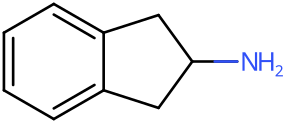
2-AI Stats & Data
NC1Cc2ccccc2C1LMHHFZAXSANGGM-UHFFFAOYSA-NToxicity
PsychonautWikiThe toxicity and long-term health effects of recreational 2-AI use do not seem to have been studied in any scientific context and the exact toxic dosage is unknown. This is because 2-AI has very little history of human usage. Anecdotal evidence from people who have tried 2-AI within the community suggest that there do not seem to be any negative health effects attributed to simply trying this drug at low to moderate doses by itself and using it sparingly (but nothing can be completely guaranteed). It is strongly recommended that one use harm reduction practices when using this drug.
Effect Profile
Curated + 10 ReportsStrong focus and euphoria with strong anxiety/jitters, mild stimulation
Tolerance & Pharmacokinetics
drugs.wikiTolerance Decay
Pattern inferred from transporter‑releasing stimulants and community reports: fast within‑session tachyphylaxis with decay to near‑baseline in ~7–10 days. Exact magnitudes are uncertain.
Cross-Tolerances
Experience Report Analysis
ErowidDemographics
Gender Distribution
Too few reports for a chart: gender is known from 12 reports, and a split is drawn only from 20 reports or more. Counts are shown instead. Why 20?
- Male 11 of 12
- Not Specified 1 of 12
Age Distribution
Reports Over Time
Effect Analysis
ErowidEffects aggregated from 10 experience reports (10 single-substance Erowid)
Effect Sentiment Distribution
Confidence Distribution
Each bar is the share of reports mentioning the effect; its whisker, and the band on the rows below, is the 95% interval: where the share could plausibly be with other reports of the same kind.
Too few reports for bars: these effects come from 10 single-substance Erowid reports, and a bar is drawn only from 20 reports or more. With fewer, a percentage cannot tell a common effect from a rare one. Counts are shown instead. Why 20?
Positive Effects 2
Adverse Effects 2
Show 1 neutral or unclassified mention
Form / Preparation
Most common forms and preparations, as a share of the 9 reports that give one
Too few reports for bars: these forms come from 9 reports, and a bar is drawn only from 20 reports or more. With fewer, a percentage cannot tell a common effect from a rare one. Counts are shown instead. Why 20?
- Powder / Crystals 7 of 9
Harm Reduction
drugs.wiki— Pharmacology: In vitro profiling shows 2‑aminoindane acts as a monoamine transporter substrate with higher potency at NET and DAT than at SERT, and it binds α2‑adrenergic receptors at low‑to‑mid‑nanomolar Ki, consistent with reports of peripheral vasoconstriction, piloerection and mild analgesia. This profile distinguishes it from serotonergic aminoindanes such as MDAI. — Dose uncertainty: Formal human dose‑finding data are lacking; community reports vary widely, from inactive at 10–20 mg oral to clear stimulation at 50–100+ mg, with rectal administration increasing intensity. Start low, especially with new batches. — Duration and redosing: The active phase is short, but residual stimulation can prolong into insomnia; repeated redoses compress sleep and may precipitate anxiety or paranoid thoughts. Build a clear ‘no‑redose after X hours’ rule before starting. — Cardiovascular risk: Expect elevations in BP/HR; those with hypertension, arrhythmia, or other cardiovascular disease should avoid. Seek urgent care for chest pain, severe headache, confusion, or temperature >38.5 °C. — ROA risks: Intranasal use is notably painful and damaging to mucosa; use isotonic saline rinses if mistakenly insufflated. Rectal use should employ sterile water, body‑temperature isotonic solution and clean syringes (no needles), and precise volumetric dosing; avoid if there is rectal bleeding or inflammation. — Comedown/sleep: Prefer non‑pharmacologic sleep hygiene first (dark room, magnesium glycinate, hydration). If a sedative is used, avoid alcohol co‑use and do not stack multiple depressants. — Drug checking: Aminoindanes/NPS are frequently mis‑sold; confirm identity with multi‑reagent testing and, ideally, lab analysis (GC/MS/FTIR). Reagent color reactions for 2‑AI are inconsistent across batches; treat color tests as presumptive only. — Tolerance: Acute tolerance rises quickly during a session and decays over about a week; spacing sessions ≥7 days is prudent.
References
Cited references
- PubChem compound record for 2‑aminoindane (CID 76310)
- 2‑Aminoindan transporters and α2‑adrenergic receptors
- Synthetic Aminoindanes: Summary of existing knowledge (user dose ranges, context)
- Indantadol (CHF‑3381) human PK/PD; 2‑AI measurable as metabolite (inference source)
- Erowid 2‑Aminoindan Basics (dose/contraindications caveats)
- Bluelight rectal bioassay (~100–200 mg; ~2 h rush; insufflation painful)
- Bluelight user thread (oral ~68 mg; peripheral bodyload)
- Reddit r/researchchemicals — 2‑AI 100 mg oral self‑experiment; notes on variability
- TripSit Drug Combinations (general stimulant combo cautions)
- Drugs‑Forum Research Chemical Index (2‑AI entry acknowledges limited human data)